Sayyid Al-Hakeem: Government Formation Delays Common Parliamentary Systems
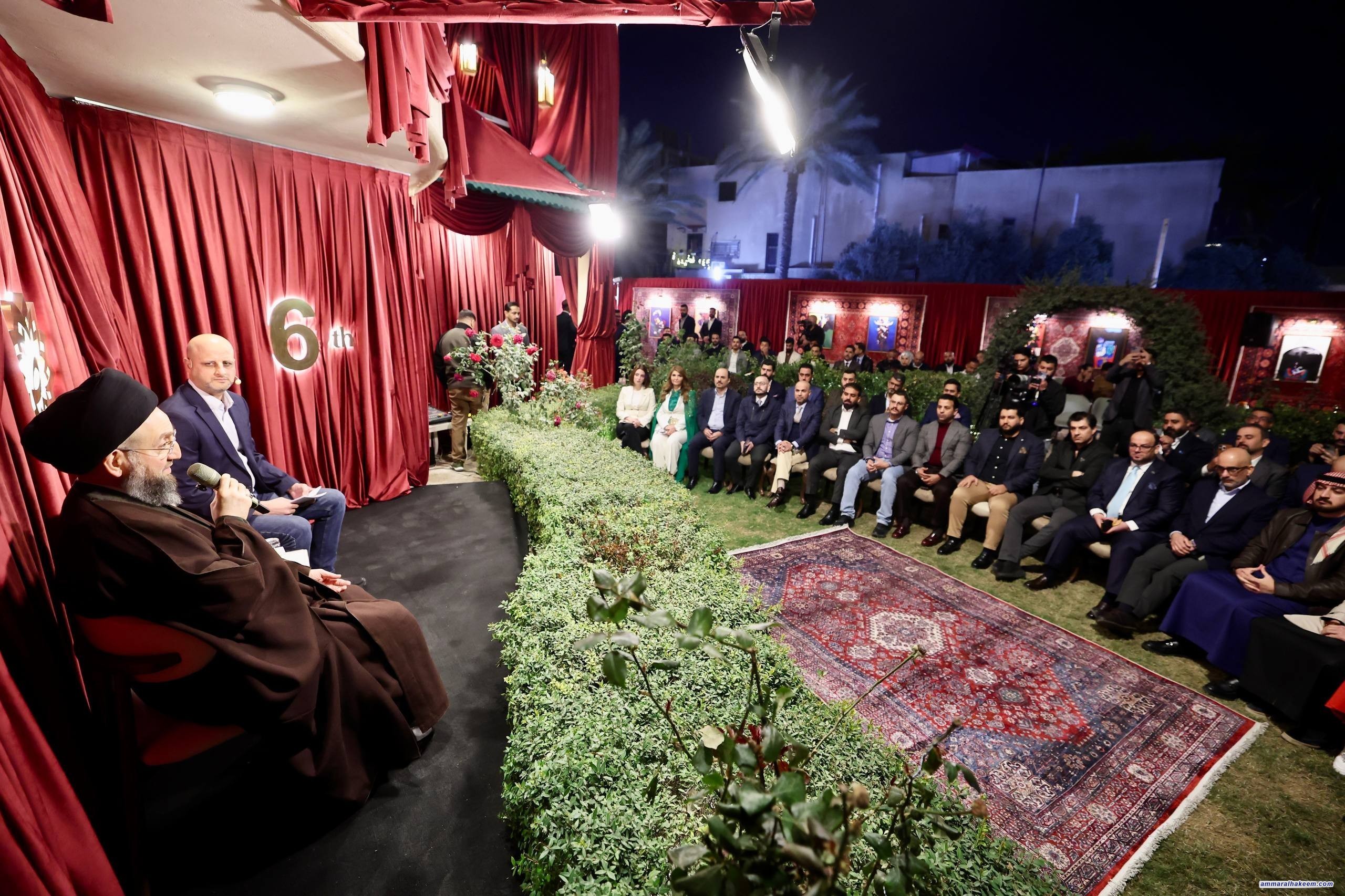
His Eminence Sayyid Al-Hakeem, Head of the National State Powers’ Alliance, attended the Iraqi House Salon where H.E. extended congratulations to the attendees on the arrival of the holy month of Ramadan. H.E. remarked: “We had hoped that the negotiations would lead to flexible positions, and this was reflected in the most recent session, which created the impression that the issue could be resolved without military intervention.” H.E. expressed strong condemnation of what occurred today, describing it as a unilateral step carried out without international cover, and voiced hope that the parties would return to the negotiating table to spare the region a devastating war whose consequences would be difficult to predict.
H.E. also stressed the importance of safeguarding Iraq’s security, calling for restraint and urging that the country be protected from the repercussions of escalation. H.E. noted that Iran’s conduct today differs from its behavior on the first day of June last year, a development that could open the door to renewed understandings.
H.E. further observed that historically the Iranians tend to grow more resolute in the face of challenges, emphasizing that dialogue could have been relied upon to ensure that Iran does not acquire a nuclear weapon.
H.E. indicated that Iraq had received assurances that it was not a target for any party; however, this did not materialize, as several Iraqi sites were subjected to bombardment, stressing that the government bears responsibility for protecting Iraq’s security.
H.E. added: “The Coordination Framework has nominated a candidate, with some of the powers supporting the nomination while others remain cautious. Delays in forming the Iraqi government are not unusual; they are common in parliamentary systems. We warn against placing the country’s interests before difficult circumstances and obligations. Preserving stability and safeguarding the achievements that have been realized remain essential.”
H.E. explained that efforts are underway to settle the nomination issue, reaffirming that the dignity of the country stems from the dignity of its people and the interests of its citizens. H.E. also called for careful assessment of the situation and for recalling the suffering endured by Iraqis during the years of economic sanctions, noting that solutions are possible in a manner that safeguards the interests of all.
H.E. clarified that His movements outside Iraq represent a national Iraqi effort that speaks for all Iraqis and carries their interests and concerns, emphasizing the importance of enduring media campaigns for the sake of Iraq.
H.E. affirmed that linking the selection of the President of the Republic to another issue is incorrect, noting that the Kurdish parties can proceed with reaching agreement on a candidate and then elect that candidate within the Council of Representatives.
H.E. also stated that the current members of the Council of Representatives attained their positions through constitutional means, adding that Al-Hikma National Movement does not complain about the consequences of its moderation and centrism, as this approach is a principle from which it cannot deviate. H.E. further indicated that the current government is a caretaker administration handling daily affairs, and that H.E. does not support detailed discussions about extending the tenure of a caretaker government.
H.E. remarked: “The Coordination Framework was established to coordinate positions and reach a shared understanding that leads to acceptable outcomes. There has been a vote within the Framework to institutionalize it and establish internal regulations, taking into account the relative weight of members based on the number of seats held by each bloc. We are working to further develop this experience, and other components have begun drawing inspiration from the Framework’s model.”
H.E. concluded by noting that Iraq is inevitably affected by developments in the region, recalling the importance of identifying alternative routes for exporting Iraqi oil. H.E. expressed regret that such proposals have not been handled appropriately, stressing that regional developments should help resolve the outstanding issues within the country, as challenges often carry opportunities for Iraq.


