Sayyid Al-Hakeem From Baghdad Diwan: Iraq Moves Past Challenges, Stability, Constitutional Commitment Reinforces Recovery Messages
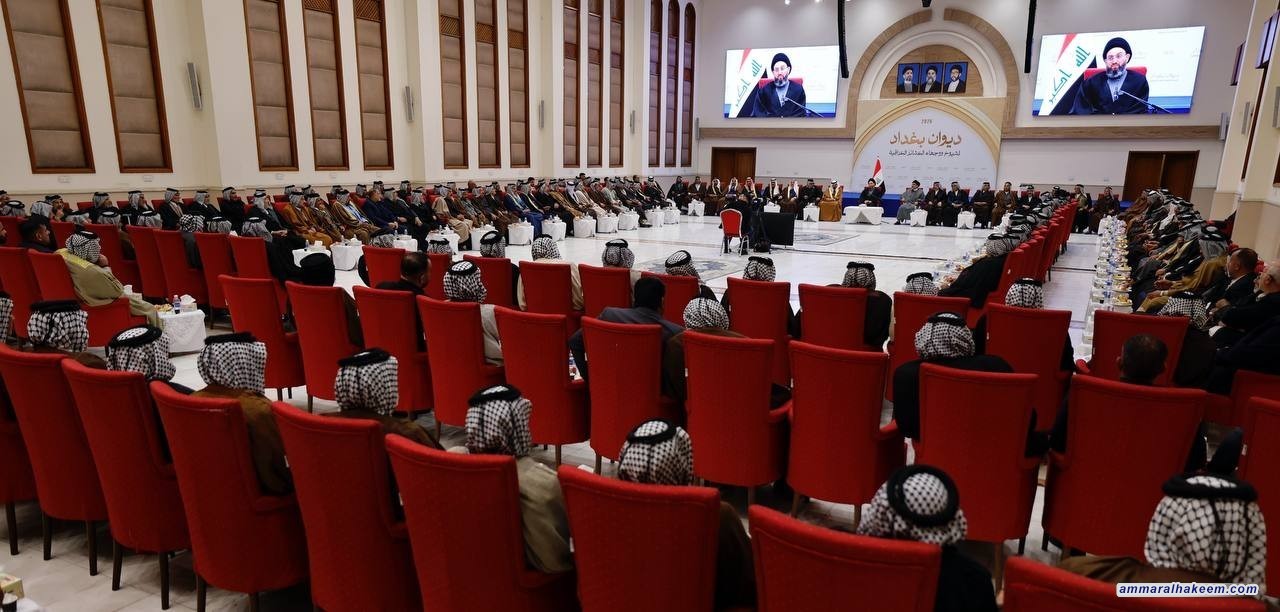
His Eminence Sayyid Al-Hakeem, Head of the National State Powers’ Alliance, welcomed Iraqi tribal sheikhs and dignitaries at the Baghdad Diwan, extending congratulations on the advent of the blessed month of Rajab and recalling its occasions with their moments of joy and reflection.
His Eminence affirmed that Iraq has endured complex security, social, and political challenges, compounded by limited regional understanding of the country’s transformation. H.E. noted that, by the grace of Allah, the guidance of the Supreme Religious Authority, the wisdom of political and social leaders, and the awareness and solidarity of Iraqi tribes, Iraq has overcome these challenges and entered a phase of stability and recovery.
H.E. pointed out that Iraq concluded the mission of the international coalition against ISIS, relying on the capabilities of its armed forces to secure the country and shifting toward bilateral relations with states. H.E. also highlighted the conclusion of the United Nations Assistance Mission for Iraq (UNAMI), stressing that these steps constitute clear messages of recovery and demonstrate Iraq’s ability to resolve its issues independently.
His Eminence explained that the recent elections sent an important recovery signal through sound practice, swift announcement of results, and the absence of major complaints or doubts about integrity. At the same time, H.E. called for full transparency in public spending and for refraining from exploiting state resources or exerting pressure on security institutions for electoral gains, emphasizing that a strong state can address such issues.
H.E. urged attention to the high voter turnout and international endorsement of the elections, considering this evidence of Iraqis’ commitment to their political system and unity around it. H.E. noted that this climate facilitates political understandings and adherence to constitutional timelines, particularly the completion of electoral entitlements, the election of the President of the Republic, and the designation of the largest bloc’s nominee to form the government.
His Eminence clarified that the Coordination Framework carries two core tasks, foremost electing a Prime Minister through consensus built on dialogue. H.E. explained that the Framework reviewed candidates’ priorities, visions, programs, teams, and approaches to challenges, resulting in the nomination of nine candidates from forty-two, with dialogue continuing to reach an agreement that preserves unity and satisfies all parties.
H.E. affirmed that the Coordination Framework contributed to bridging views among political forces across components and played a role in the understandings that led to the election of the Speaker of Parliament and the two deputies, alongside efforts to encourage Kurdish consensus on a single nominee. H.E. stressed that adherence to constitutional deadlines, political maturity, and awareness of internal and external challenges are positive recovery indicators.
Addressing economic challenges, His Eminence highlighted pressure from oil prices on the general budget, noting that these challenges also present real opportunities for economic remedies by activating productive sectors—agriculture, industry, tourism, investment, and technology—and moving beyond a rentier-state model. H.E. emphasized that state strength is inseparable from economic strength and recovery.
On security, H.E. stated that the security challenge has ended, commending the substantial efforts made to protect Iraq. H.E. called for continued dialogue and negotiation with armed factions and the international community to reach balanced solutions that honor sacrifices and open pathways for political participation, underscoring that Iraq’s security is tied to regional stability.
Regarding water, His Eminence described the water crisis as a regional and global challenge requiring negotiations with upstream countries, modernization of irrigation and agriculture, conservation of water resources, adoption of modern technologies, investment in groundwater, and seawater desalination.
In services, H.E. called for a fair system for salary distribution among public employees and for narrowing disparities. H.E. also stressed advancing the healthcare system, activating the family doctor project to ease pressure on health institutions, and noted that the program supporting the poorest governorates has contributed—and continues to contribute—to improving conditions in those areas.


